From Capture to Create: The Evolution of Competitive Wildlife Photography
Wildlife photography, including bird photography, has gone through several phases for some photographers during the 35 years that I have been involved in wildlife photography.
For others, however, it has remained much the same over time—or, judging from what I see today, it is still essentially where it was decades ago.
This latter conclusion is based on my observations over many years and again confirmed in 2024-6 as a judge for photographic clubs and salons, as well as an assessor of honours for PSSA and as chair for PSA portfolios recognition.
During my slide-photography period (1993–2004), good light—typically early morning or late afternoon—was essential if you wanted to achieve a club gold or a salon acceptance.
In many cases, good light was almost more important than the required composition, which generally meant placing the subject according to the rule of thirds, ensuring absolute sharpness and having a visible catchlight in the eye. Full-frame images, or very tight cropping, were also the norm.
The subject matter was, in most cases, simply a “voëltjie op ’n stokkie” (bird on a twig) or a waterbird swimming. A kingfisher with a catch, sitting “on a twig” in good light with a clean background, could be enough to win a salon.
To be successful with slide photography, you needed a deep understanding of the relationship between shutter speed, aperture and film speed (ISO), as well as the ability to change these settings quickly in the field. You also had to master manual focusing to capture birds successfully.
There was very little room for error. Once the shutter had been pressed, the frame was captured on film—and you had to wait until the film was processed before you knew whether you had succeeded.
Then technology made a major step forward.
Digital photography, together with basic autofocus, opened a completely new world for adventurous photographers. Birds in flight became somewhat easier to photograph, and action images started appearing more frequently.
The next major technological advances were larger and higher-resolution sensors, much faster shutter speeds, improved autofocus and significantly reduced noise at higher ISO settings.
Cropping became increasingly practical without losing too much detail, which was particularly important for action and bird-in-flight photography.
The ability to shoot at ISO 12,800 or even higher is light-years away from the ISO 50 of high-quality slide film, resulting in extremely slow shutter speeds—even with a 600mm f/4 lens, a 1/60th of a second or slower…
But I believe the real equalizer between the novice and the highly experienced wildlife photographer arrived only a few years ago with mirrorless cameras and the extraordinary level of automation made possible by very fast processors and the mirror no longer required.
Subject and eye recognition, extremely fast autofocus and tracking, pre-capture, shutter speeds of 1/8,000 second and faster, 50-megapixel sensors and shooting speeds of 30 frames per second or more have become the norms of modern high-end wildlife photography.
Once the mirrorless camera has been properly configured, the biggest challenge left to the photographer is often simply to keep the moving subject in the viewfinder and press the shutter.
The camera no longer requires an experienced or particularly innovative operator to capture technically excellent action images of birds in flight or birds interacting with their environment.
And this has fundamentally changed the competitive landscape.
Modern technology has raised the bar enormously when it comes to what can be captured.
Almost anyone with a modern mirrorless camera can now produce an excellent image of a bird in flight with prey—for example, a Goshawk carrying prey or a heron carrying nesting material.
These images were extremely difficult to capture consistently 20 or 30 years ago. Today, however, thousands of photographers do so.
This brings me to two very important questions: How can the innovative photographer differentiate his or her work? Why do we still see so many nature-salon and honours images that, in terms of impact and visual approach, resemble the photography of the slide era?
Let me address the second question first.
Most photographers will probably go through what I call the “slide criteria” phase during their development. They learn at their photographic clubs, follow what is being rewarded in salons and often draw inspiration from wildlife coffee-table books.
There is absolutely nothing wrong with this as a learning phase.
The problem arises when photographers never move beyond it — even though their modern equipment gives them the opportunity to explore completely new possibilities.
In my opinion, one reason is that photographers are often rewarded at club level for producing precisely these conventional images. They are not always encouraged by judges to move beyond the established criteria.
Another factor is that many club judges are not wildlife photographers themselves. They may therefore judge wildlife images according to general photographic principles and established conventions rather than from the perspective of progressed wildlife photography.
The same, in my view, can sometimes apply to nature-salon and honours judging.
The fact is also that most photographers are too scared to go too deeply into the complicated menus of their impressive mirrorless machines and never dare to experiment on their own with the possibilities that it offers to create in addition to capture only.
As a result, I believe that we will continue to see a large proportion of conventional, slide-era-style images entering clubs, salons and honours submissions.
I had my own years of club and salon photography, both nature and non-nature. However, in the early 2000s I ventured into serious wildlife competition photography at both national and international level.
I learned very early that this is a completely different world from conventional club and salon photography where a predetermined percentage—often around 20–25% of the entries—are accepted, irrespective of the overall quality of the submitted images (normally roughly around 1000 images). As a result, some images that are merely adequate, or even below what one might regard as good slide-era standard, may still receive an acceptance simply because the judging system requires a certain proportion of the entries to be accepted.
Elite photographic competitions operate on an entirely different principle. There is no obligation to fill an acceptance quota. The standard is determined by the quality of the images, and the level of competition is exceptionally high. A good example again is the Natural History Museum’s Wildlife Photographer of the Year competition, where a relatively tiny number of images are selected from tens of thousands of entries. In such an environment, being technically correct or simply showing a beautiful and well-exposed animal is no longer enough.
It is a totally different game.
To enter this world, the login name is “Different,” and the password is “Unique.” With the absolute key to success = IMPACT!
Already in those years, successful competition photographers had to break away from the trends of mass photography and conventional club and salon images.
Today, that is even more important.
Modern equipment made it significantly easier to produce technically excellent wildlife images. Therefore, technical excellence alone is no longer enough.
I have learned that to be successful in serious competition photography, you need to CREATE and not merely CAPTURE.
Consider the scale of competitions such as the Wildlife Photographer of the Year. With tens of thousands of images competing for recognition, the probability of standing out through technical excellence alone is extremely small.
It is no longer enough to capture what everyone else can capture.
I have studied the winning and highly ranked images from many international wildlife competitions, and one thing has repeatedly stood out to me:
Give the subject space.
Do not automatically crop tightly.
Show the environment.
Tell the story.
There will always be situations where a tightly cropped image is the strongest solution because it focuses the viewer’s attention on the subject. The point is not that tight cropping is wrong. The point is that cropping should be an artistic decision—not simply a consequence of the photographer’s inability to get close enough.
The environment can provide context, atmosphere, scale, emotion, and storytelling. Sometimes the bird itself is only part of the story.
I have therefore changed my own approach to wildlife and specifically bird photography.
Instead of simply trying to capture a technically perfect subject, I increasingly try to create an image. I look for opportunities to show behaviour, interaction, environment, atmosphere, movement and relationships and to accentuate or change it with specific camera settings. I try to ask myself how can I use my camera settings to create impact and something different?
The modern camera is exceptionally good at capturing the moment.
The challenge for the modern wildlife photographer is therefore no longer simply to capture the moment. The photographer must now learn and decide on the spot how to use the tool in his hand innovatively as a brush to paint something different…
I will attempt to illustrate this change in my approach with a selection of my own more “modern” bird images.
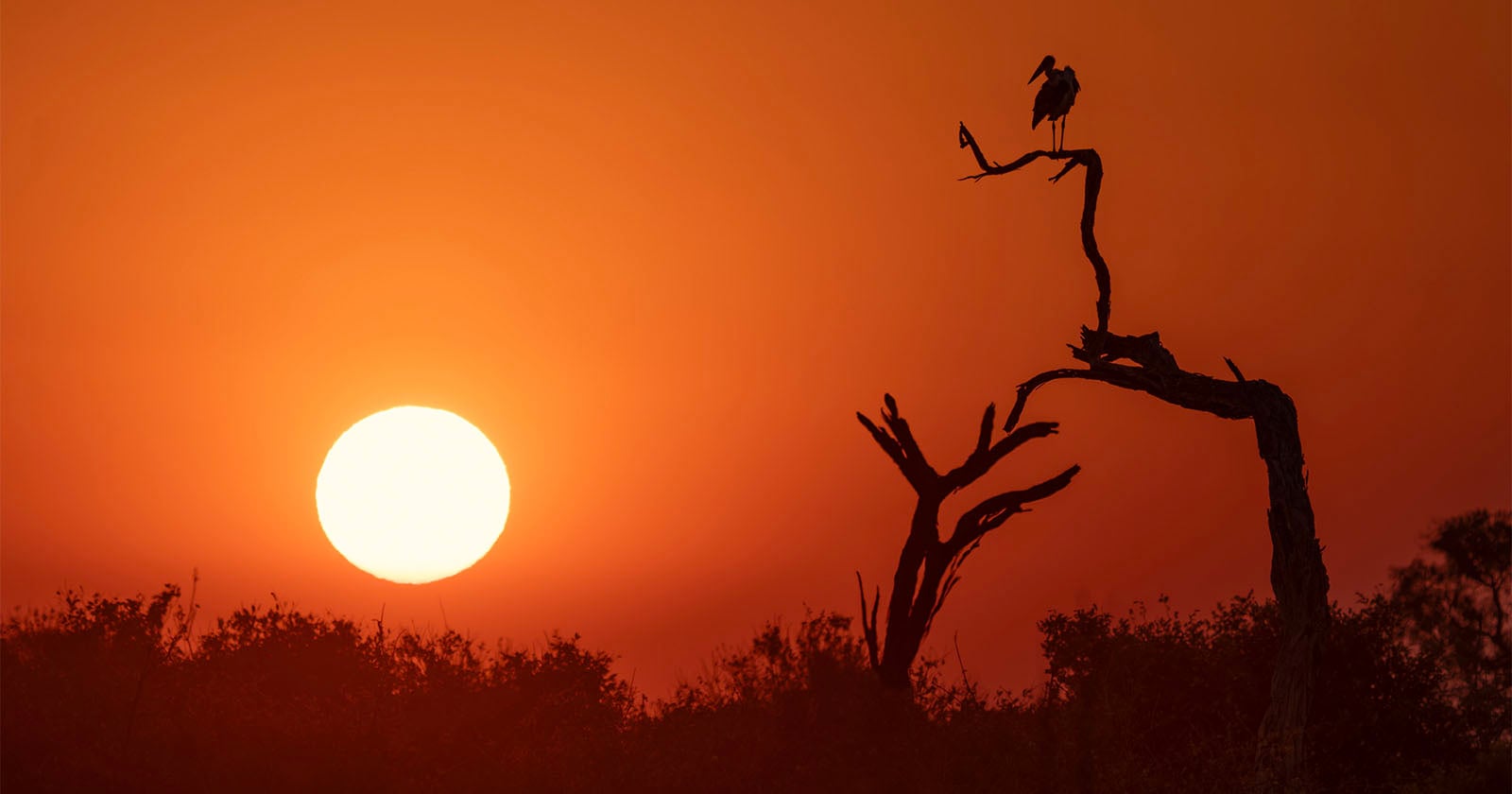
I noticed this perch on several game drives, together with the position of the setting sun, and immediately saw the potential—but there was never a bird to be seen.
I returned to the site at sunset several times. Then, on this particular afternoon, the Marabou stork was already waiting on the perch an hour before sunset. I waited as the sun dropped and the sky became this deep, glowing red.
The image is simple, but it carries a strong sense of another day passing: a bird settling in for the night against a glowing red sky, safe on its high perch in a dead tree. The stork is a very small part of the frame, yet without it, the photograph would not tell the same story.
In the next image, I had to use a high shutter speed of 1/8000s and an aperture of f/9 to get the red-billed queleas all sharp in flight and on landing.
The image has no specific point of interest, but the mass of birds creates the impact. I also tried another route. I used a very slow shutter speed to blur the birds in flight but wanted to keep the ones on the ground sharp. I could only achieve this with a shutter speed of 1/20s, aperture of f/20, and ISO of 50.
This approach created a stronger, image withmore immediate impact. The question is: How can I enhance its impact further?
Did I create more impact with this high-key black-and-white conversion with post-capture processing? Maybe…?
It is very difficult to photograph ostriches in the wild with a high-impact result.
I tried various techniques in different situations” – Underexposing a backlit ostrich running in a dusty area – Overexposing at a slow shutter speed when dust bathing – The most rewarding was however when a parent ostrich took a rest with it’s chicks in a white sand road and gave them shade with it’s wings. I have decided to deliberately crop most of the adult off by using a long lens and focus on the chicks.
Action images are still important and always have high impact when zoomed in on the action. I followed this secretary bird for a good 90 minutes and when it finally made this kill and threw the lizard up in the air, I was ready…I captured the image as is with a long lens.
In conclusion, modern technology has made technically excellent wildlife photographs more achievable than ever before.
To stand out however, wildlife photographers have to move beyond simply capturing a sharp, well-exposed wildlife scene. The real challenge is to create images with originality, impact and meaning by using composition, environment, behaviour, light and camera techniques to tell a stronger visual story. Technical skill remains important, but creativity and a distinctive personal vision are the difference between just another image and a winning image.