X-Ray Telescope Celebrates America's 250th Birthday With Cosmic Fireworks
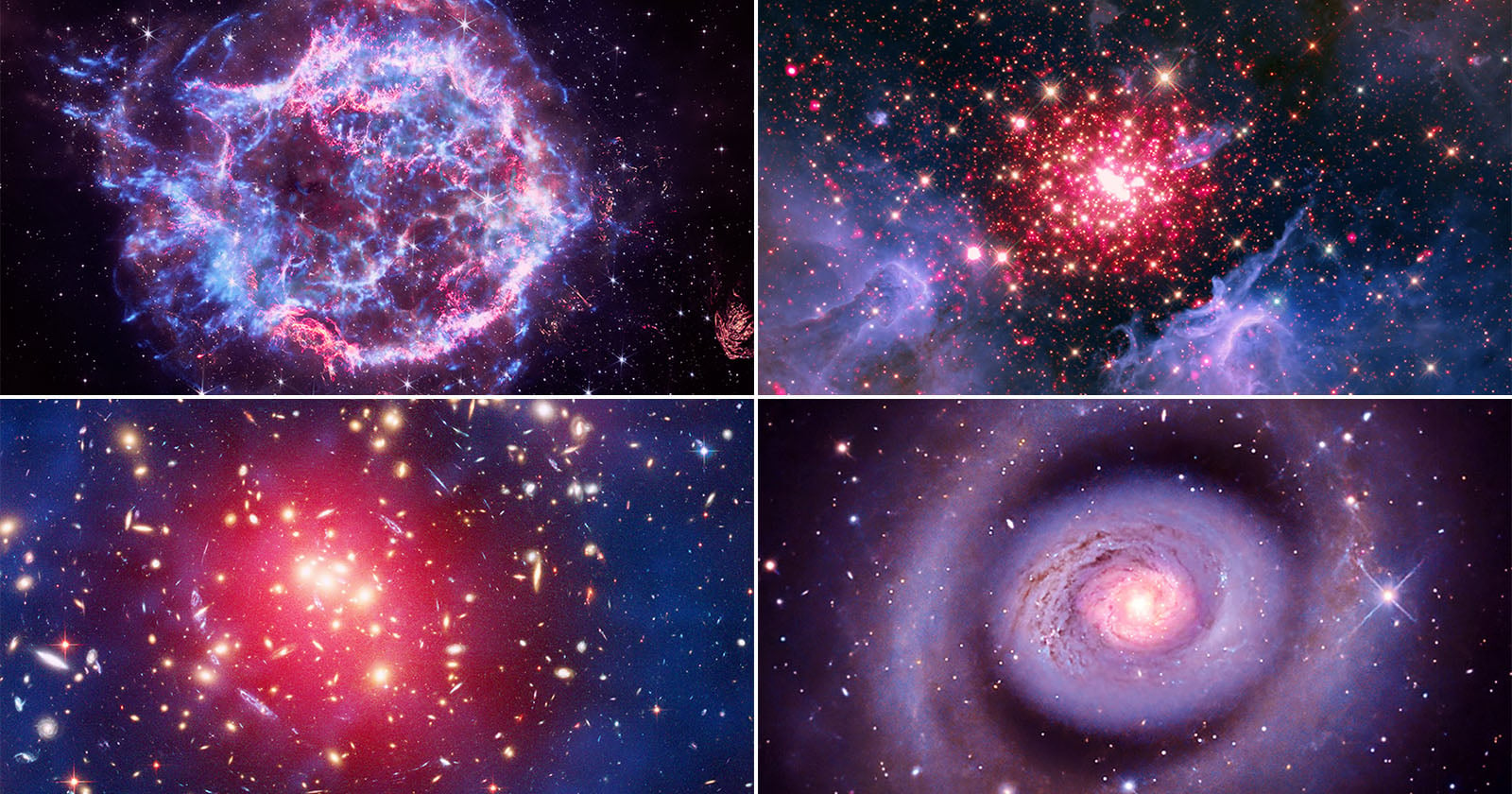
In celebration of the United States of America’s 250th birthday, NASA has unveiled four new images from its Chandra X-ray Observatory that show the wonders of the Universe in resplendent red, white, and blue.
Chandra’s new set of space photos, which NASA says depict “four wonders of the Universe,” includes some cosmic heavy-hitters. The first image shows Cassiopeia A. Chandra’s X-ray wavelengths are depicted in beautiful blue and purple and have been combined with data from the James Webb Space Telescope (JWST), shown in red and white.
“Chandra’s X-ray vision reveals the blast wave that tore through the star, as well as elements in the debris field like iron, calcium, and oxygen,” NASA explains. “Webb’s infrared data also shows the expanding shell of material from the explosion and cosmic dust throughout the remnant.”
Next up is NGC 3603, a “colossal and brilliant star factory” located in the Milky Way galaxy’s Carina spiral arm. In this image, scientists combined X-ray data from Chandra (the red central portion) with optical imaging data from the Hubble Space Telescope. Hubble captured the towering pillars of cosmic gas and dust, while Chandra showed a dense, “sparking swarm” of young, massive stars. This is one of the many places in the cosmos where new suns are born.
NGC 4726, also known as Messier 94, combines X-ray wavelengths (red, orange, and blue) with visible light data that citizen scientists captured using their telescopes on the ground on Earth (red, green, and blue). Messier 94 is a beautiful spiral galaxy with a bright inner ring, called a starburst ring, which is where new stars are constantly forming.
Rounding out the quartet of new Chandra images to celebrate America’s 250th anniversary is ZwCL 0024+1652. This is a very distant galaxy cluster in which astronomers have discovered evidence of dark matter. This discovery was made thanks to specially processed data from Chandra (red) and Hubble (blue). Another Hubble image helped form this final composite, and its data appears in yellow and white. Chandra’s X-ray camera reveals a huge reservoir of superheated gas.
Alongside these four new images, NASA also released sonifications of three of them. This novel technique translates telescope data into sound, where the brightness of the data dictates the sound itself.
Image credits: X-ray: NASA/CXC/SAO; IR/UV: NASA/ESA/CSA/STScI/AURA; Image Processing: NASA/CXC/SAO/L. Frattare and K. Arcand