Filmmakers Captured a Rocket Launch With a Blackmagic Immersive Camera
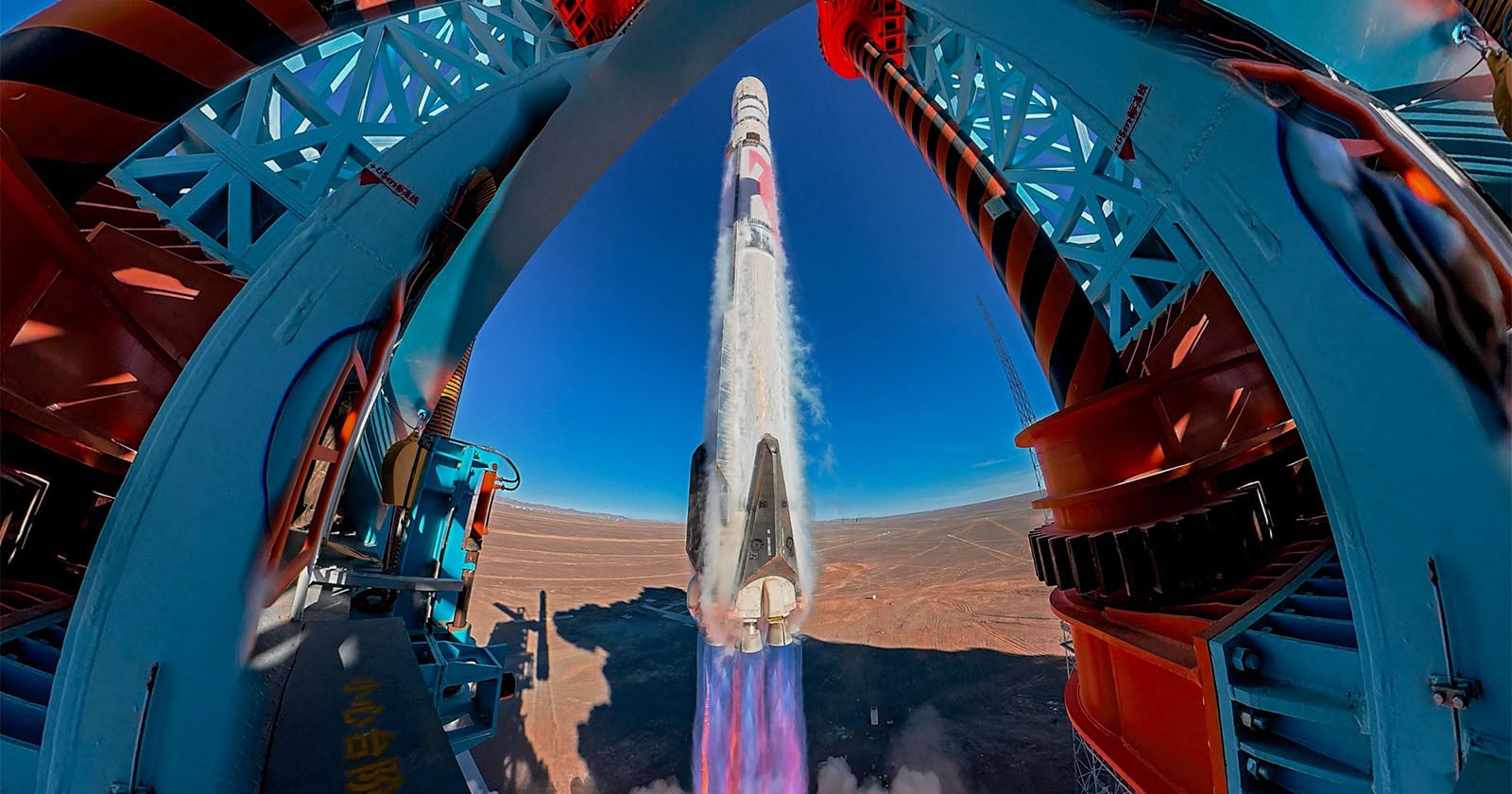
Chengdu Qiongjie Yingchuang Culture and Entertainment is a Chinese immersive imaging company. It recently captured a rocket launch on the Gobi Desert using Blackmagic Design’s extremely impressive Ursa Cine Immersive camera, capable of capturing greater than 8K resolution video across two lenses, one for each eye in an Apple Vision Pro headset.
The team, Tang Yisu, Gan Yujie, and Lu Linxuan, captured a historic rocket launch with Blackmagic’s immersive cinema camera. Private Chinese space company LandSpace launched its reusable Zhuque-3 rocket at the Jiuquan Satellite Launch Center in China. It is a major accomplishment for China’s commercial spaceflight ambitions.
Cinematographer Tang Yisi tells Blackmagic Design that Chengdu Qiongjie Yingchuang records a lot of immersive video content using the Ursa Cine, including immersive music videos and documentaries to large-scale commercial experiential content.
This new project, “Land Your Dream in Space: Zhuque-3 Launch Vehicle Flight Test Mission,” is believed to be the first Apple Immersive Video of a rocket launch. The launch itself took place late last year, and the video documenting the mission was edited in DaVinci Resolve Studio and then packaged for direct playback on Apple Vision Pro.
“We chose to document this mission using immersive video because traditional video cannot truly bring viewers back to the launch site to witness the spectacle firsthand, whether they are members of the general public eager to see a rocket launch, or engineers working behind the scenes at LandSpace,” Yisu explains.
Apple Immersive Video is ultra-high-resolution and offers a 180-degree field of view, enabling a perspective on a rocket launch unlike anything before.
Editor Lu Linxuan says the Blackmagic Ursa Cine Immersive was the right tool for the job because of its high resolution and frame rate. It records footage at 8,160 x 7,200 resolution per eye at up to 90 frames per second.
“For us, immersive video is more like theater. Instead of merely watching, the audience is brought directly onto the stage. The director no longer dictates where viewers look primarily through camera language but instead guides their attention in much subtler ways,” Linxuan continues. “Immersive camera language must be more restrained. Most shots are captured statically on tripods. Common movements in standard 2D cinematography, such as pushes, pulls, pans, and tilts, are not always suitable for immersive shooting.”
The immersive filmmakers have a strong sense of how people will move their eyes during different sequences and can work around those expectations. In the case of a rocket launch, viewers instinctively want to look up at the rocket as it ignites and launches into space at breakneck speed. So they set up the Ursa Cine Immersive at ground level, ensuring they had a wide field of view so people could look up.
The crew also took full advantage of Ursa Cine Immersive’s professional-grade build quality, as the Gobi Desert features heavy dust, rapidly changing temperatures, and both extreme heat and cold. The camera easily handled the video recording assignment and worked well for timelapse recording.
Immersive filmmaking remains a relatively new segment, but there’s little doubt that immersive video inside devices like Apple Vision Pro enables an entirely new level of immersion and new ways to experience documentaries and movies. It also means that filmmakers have to approach the medium differently and utilize new equipment. It’ll be fascinating to see where the immersive video space goes in the coming years. Maybe it’ll even go into space itself one day.
Image credits: Blackmagic Design, Chengdu Qiongjie Yingchuang Culture and Entertainment