Slow-Mo Video Captures Shockwaves From the SpaceX Starship Megarocket
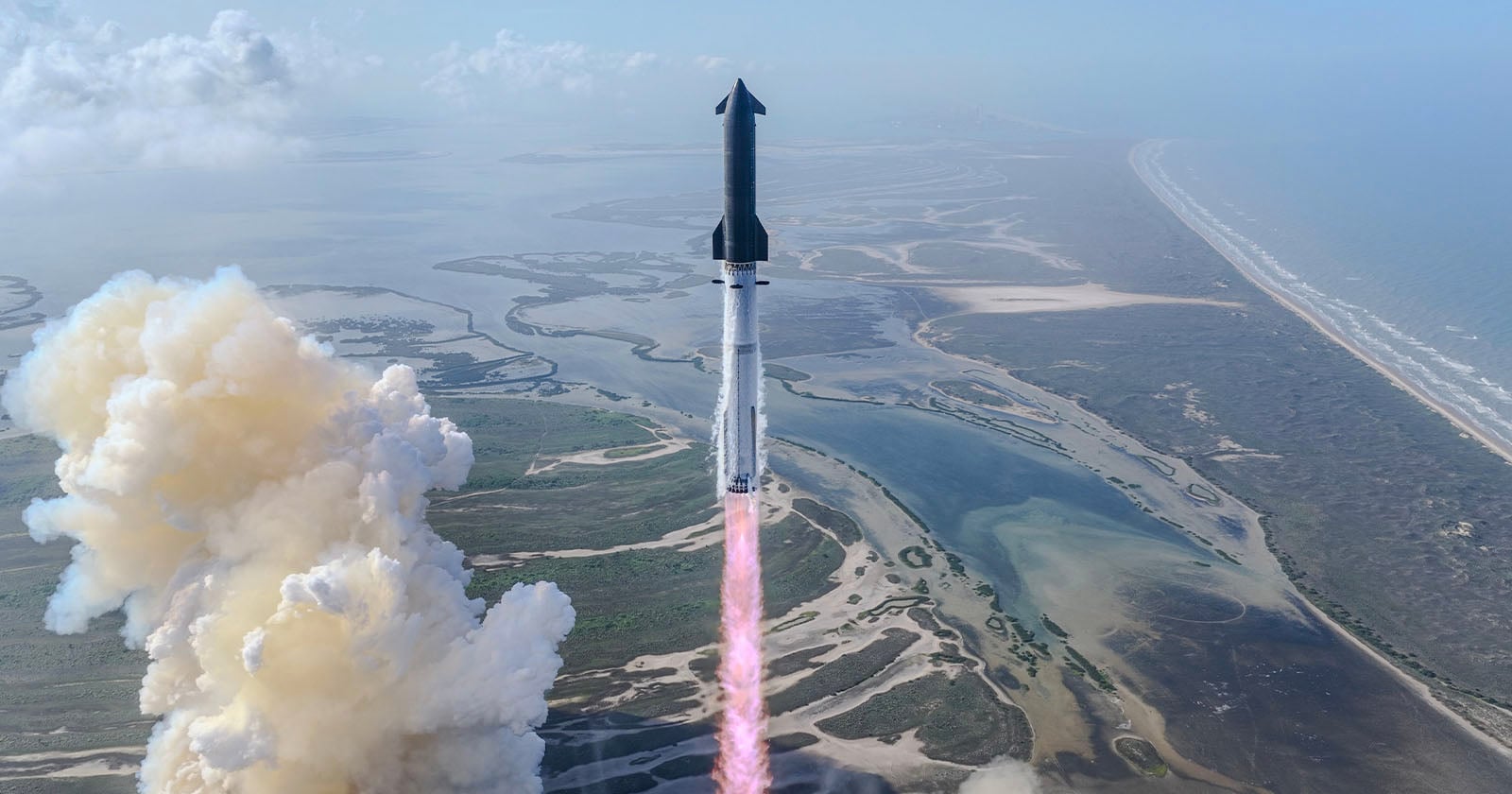
A photographer captured shockwaves rippling through the air and the smoke as the gigantic SpaceX Starship blasted off during a test run last week.
The footage was filmed at “true” 120 frames per second by Interstellar Gateway. In the video, pressure waves can be seen clearly emanating out toward the sky as the 400-foot rocket blasts off.
Starship in True 120FPS Slow-Motion.
Hello shockwaves. Watch the full below. https://t.co/jX0BwCmy19 pic.twitter.com/wZ0hRuEc2J
— IGW (@interstellargw) June 2, 2026
The waves cause the surrounding smoke and fire to light up and flicker in colorful ways. “These phenomena are fleeting at normal speed, but slow-motion photography allows people to see for the first time with the naked eye how supersonic exhaust forms visible shockwaves,” explains Angus, an X user.
“The exhaust velocity of the Raptor engines far exceeds the speed of sound, creating shockwaves that are instantaneous physical phenomena nearly impossible to track with the naked eye.”
“120 frames per second slow motion stretches time to a quarter of real speed, letting the textbook concept of ‘pressure waves traversing clouds’ be visualized and witnessed by the public,” he adds.
The shockwaves were made even more visible thanks to the pressure changes and moisture condensation in the humid air.
Interstellar Gateway says it used cinematic remote cameras to “showcase the raw power and engineering mastery of Starship V3 during its debut launch from Pad-2 on May 22, 2026.”
Liftoff of Starship V3, from the dunes right outside the pad.
This is the most insane shockwave action I have ever seen on video. Absolutely mad.
:film_projector: Me for @WeAreSpaceScout pic.twitter.com/Z5bjSFlwC5
— Cameron Schwartz (@nyoomtm) May 23, 2026
The launch was SpaceX’s twelfth test flight of its Starship megarocket. It made a dramatic splashdown in the Indian Ocean, even though it was operating without one of its engines.
SpaceX was testing a new prototype, Starship V3, which released mock satellites during its brief flight. The success of Starship V3 is very much central to Elon Musk’s planned $1.75 trillion IPO of the company.
“SpaceX did not need perfection from this Starship flight. It needed proof that the upgraded vehicle is moving in the right direction, and that is largely what investors saw,” Mark Vena, CEO at SmartTech Research, tells Reuters.
Image credits: SpaceX