Spectacular Moment Meteor Explodes Behind Erupting Volcano Caught on Camera
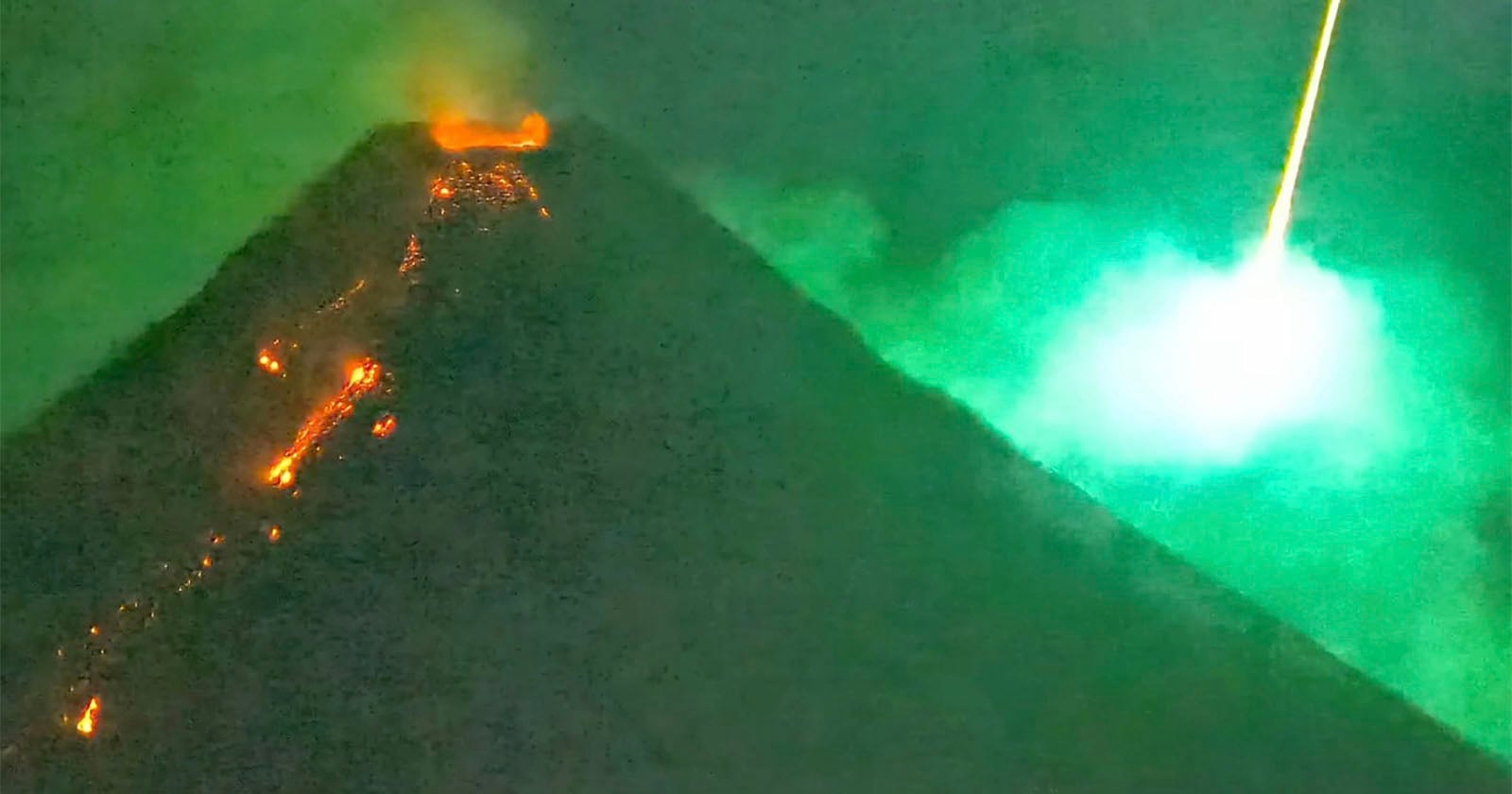
A green fireball that came from space was captured on camera, briefly illuminating an erupting volcano in the Philippines — making for spectacular footage.
The Philippine Institute of Volcanology and Seismology (PHIVOLCS) says its Lignon Hill Camera in Legazpi City captured the meteor around 10.30 P.M. on Monday (May 25). The dazzling fireball appears about eight seconds into the above video. It appears to hit the slopes of Mount Mayon, but PHIVOLCS says that’s not the case.
“Our review of seismic, infrasound and additional camera footage around the volcano indicate that the meteor disintegrated while in the atmosphere and did not strike the slopes of Mayon,” the agency says.
Live Science reports that had the meteorite struck the mountain, the potential impact may have been the equivalent to 7,500 tons of dynamite. An impact like that has the potential to trigger rockfalls that would have been picked up by the monitoring equipment.
A second camera, recording in black and white, also captured the meteor burning up, which lasted for just over a second.
PHIVOLCS explain that meteors enter Earth’s atmosphere on a daily basis, but the “vast majority burn up completely before reaching the ground.” This typically happens at altitudes of 60 to 100 kilometers (40 to 60 miles) above sea level.
“As they plunge through the atmosphere at extreme speeds, friction heats them so intensely that they vaporize. This heat also ionizes the air molecules around them, creating the bright, glowing streak we see as ‘shooting stars’. Fragments that are large enough to survive atmospheric entry and hit the ground are classified as meteorites,” PHIVOLCS explain.
The cameras are rolling on Mount Mayon because of the eruption that has been ongoing since January. Live Science notes that the active volcano stands at 8,081 feet (2,463 meters) above sea level.
“The event was visually striking with the Mayon Volcano in the foreground of PHIVOLCS’ video capture,” adds PHIVOLC. “Tracking meteor trajectories is not straightforward. Globally, scientists are able to detect and track meteors using radar and optical camera networks, coupled with data analysis and computational modeling.”
While meteorites enter Earth’s atmosphere frequently, they’re seldom recorded in such spectacular fashion. Last year, a Ring doorbell camera captured the sight and sound of a meteorite striking the planet’s surface for the first time.
Image credits: The Philippine Institute of Volcanology and Seismology