570-Megapixel Dark Energy Camera Captures the Sombrero Galaxy
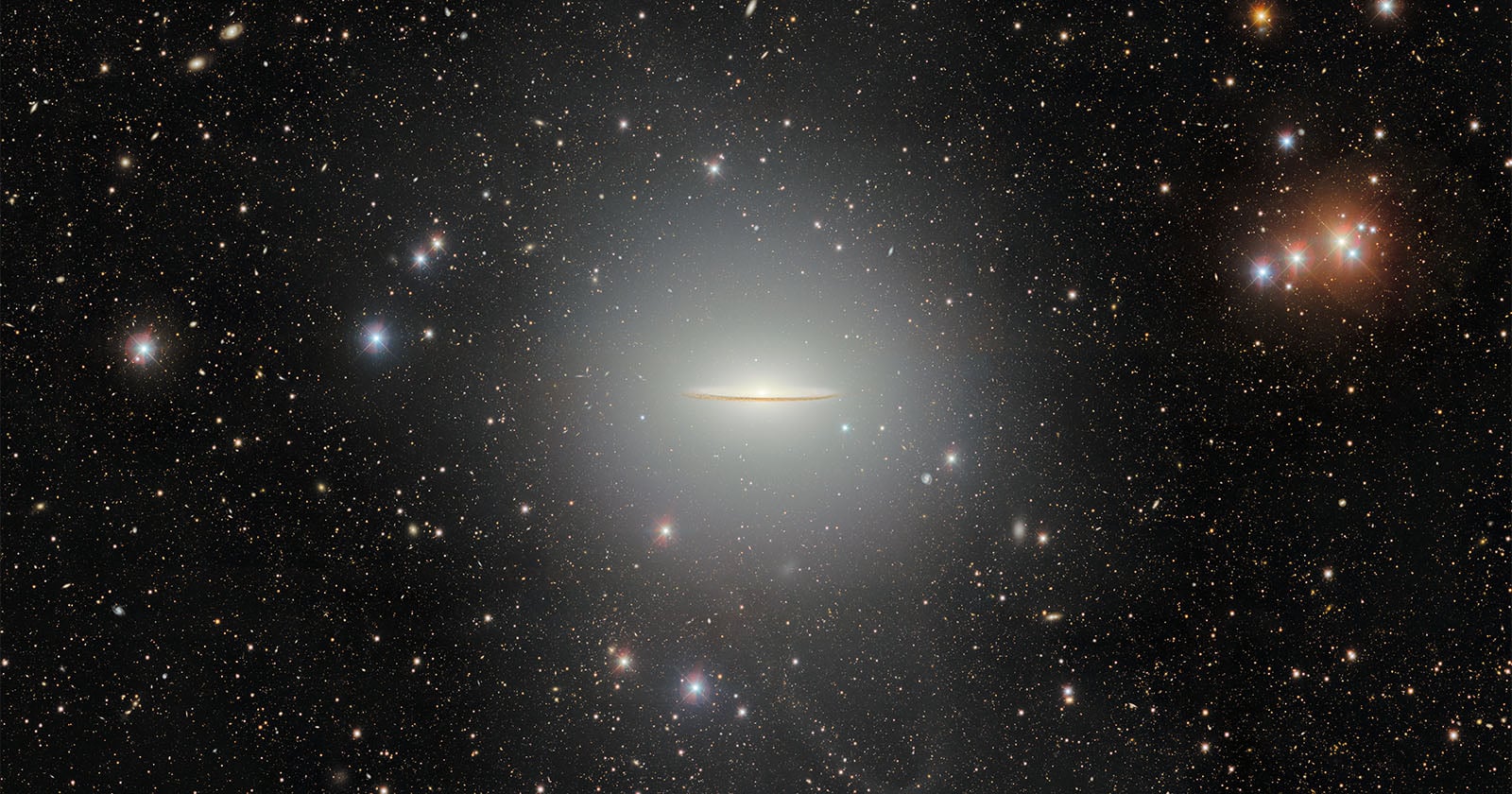
The 570-megapixel Dark Energy Camera turned its 4-meter telescope toward Messier 104, better known as the Sombrero Galaxy, and captured an exceptional side-on view of the galaxy, sometimes called “the Universe’s dusty brimmed hat.”
Messier 104, or the Sombrero Galaxy, is a very popular target among amateur astronomers. Located 30 million light-years from Earth, the glowing galaxy is an impressive 50,000 light-years across. It is among the largest objects in the Virgo Galaxy Cluster, NSF’s NOIRLab explains.
“Its alluring visual characteristics, coupled with its accessibility to amateur equipment, contribute to Messier 104’s popularity among stargazers,” NSF writes. “Amateur astronomers often enjoy observing and photographing the Sombrero Galaxy, making it a prime target for citizen science projects and public outreach efforts.”
The Sombrero Galaxy is also a compelling target for scientists. The video below shows how various space telescopes, including Spitzer, Hubble, and the James Webb Space Telescope, have imaged the Sombrero Galaxy. The Dark Energy Camera is located on Earth, at the U.S. National Science Foundation’s Victor M. Blanco 4-meter Telescope at Cerro Tololo Inter-American Observatory in Chile.
“Its intricate system of globular star clusters lends insight into stellar populations, and astronomers are intrigued by the supermassive black hole at its center,” NSF says.
Thanks to the Dark Energy Camera’s 570-megapixel CCD image sensor, scientists can investigate the Sombrero Galaxy in intricate detail.
“At its core is an intensely bright nucleus, which is surrounded by a swarm of around 2000 globular star clusters. A thin, dark band of cold dust and hydrogen gas traces the perimeter of the disk, where most of the galaxy’s star formation takes place,” NSF writes.
Also visible in the new image is the galaxy’s glowing halo, which extends to about three times the width of the Sombrero Galaxy itself. NOIRLab believes this is the first time the galaxy’s halo has been captured with this level of detail and at this expansive scale.
The Dark Energy Camera isn’t just super high-resolution, it’s also highly sensitive. Thanks to its sensitivity, the camera also captured a “sweeping stellar stream” that extends from the southern side of the galaxy. The halo and this stellar stream are home to stars that have been “torn from their home galaxies,” which suggests that perhaps there was a galactic merger between the Sombrero Galaxy and a smaller satellite galaxy in the distant past.
Image credits: CTIO/NOIRLab/DOE/NSF/AURA, Image Processing: T.A. Rector (University of Alaska Anchorage/NSF NOIRLab), D. de Martin & M. Zamani (NSF NOIRLab)