Every Photographer Should Read These Old Books
Usually, we photographers are looking at new things that have come on the market. However, historically, some fabulous books were published that are still full of incredible information.
Books delve more in-depth than most internet articles. Nevertheless, I often read something inspiring online that makes me want to learn more. Therefore, I start by hunting through my reasonable library of photography books. Failing that, I buy a book.
Although I purchase new books quite often, the ones I buy are often twenty or more years old. Some arrive in pristine condition, while others are well-thumbed and occasionally contain pencil notes from the previous owner. I love that. Books are practical things. Therefore, we should use them in the way that best serves us. Those scribbled notes in the margin add to their character.
Some older books may contain outdated or irrelevant information. However, one thing I have noticed is that there are many more deeply technical books published in the last century than are to be published today. Those released more recently tend to be more accessible. For example, a book I own, published in 1962, has graphs showing the spectral energy distribution of the North sky compared with that of direct sunlight and average daylight. It’s interesting to me, but of little value to most digital photographers. That notwithstanding, there is still excellent information gleaned from that book and other older publications.
Moreover, older books are also interesting to read because of the changes in attitude. For example, the 1948 revision of “How to Make Good Pictures, the Kodak Manual for Amateur Photographers” describes 35mm cameras (what we might refer to as full frame) as “miniature”. It classifies any negatives 2¼” x 2¼” or smaller as miniature, so most medium-format cameras would fall into that category as well.
Sometimes I browse a local second-hand bookshop to see if anything will catch my eye. Alternatively, I will search online for books on a particular topic or by a specific photographer. I prefer to use independent stores and scour awesomebooks.com and worldofbooks.com to find copies. There are plenty of other independent second-hand book sellers, such as Thrift Books, BookFinder, and BetterWorldBooks, to name a few.
There are thousands of photography books available. The following list covers just a few of the titles in my collection that are worth keeping an eye out for. Reprints of some of them are still available as current publications.
This enormous tome, published in 1998, can be found for under $10. It’s 776 large pages contain a comprehensive record of all the styles, trends, and technologies of photography and influential photographers from its birth to the end of the last century. It’s illustrated with high-quality examples of various works by Niépce and Daguerre, including those by Mark Trivier and Sophie Calle.
Published by Könemann (ISBN 3-8290-1328-0)
Also published by Könemann, this multilingual book (English, German, and Dutch) from 1995 is available in two volumes, though I have the single 896-page paperback containing both. Each chapter looks at different aspects of photojournalism, such as opera, the Olympics, Transport, Jazz, Paris, and so on. It has significant sections on the two World Wars. However, there are some notable omissions. Search the index for Lee Millar, and she isn’t there.
Part 1 is written by Nick Yapp and Part 2 by Amanda Hopkinson. (ISBN 3-9290-5032-1)
Lee Miller’s books have seen a resurgence in interest since the biographical movie Lee, starring Kate Winslet. Her son wrote both books, which offer fascinating insights into the life of a fabulous photographer. Each includes dozens of her photographs.
Apart from her fascinating life, Lee Miller was an outstanding photographer whose work shows she had an amazing eye for composition. Although the second title focuses on her work during the Second World War, her biography offers fascinating insights into her collaborations with Man Ray and her friendships and relationships within the surrealist art scene and beyond.
(Both published by Thames and Hudson, ISBN 978-0-500-29428-4 and ISBN 978-0-500-29600-4 respectively).
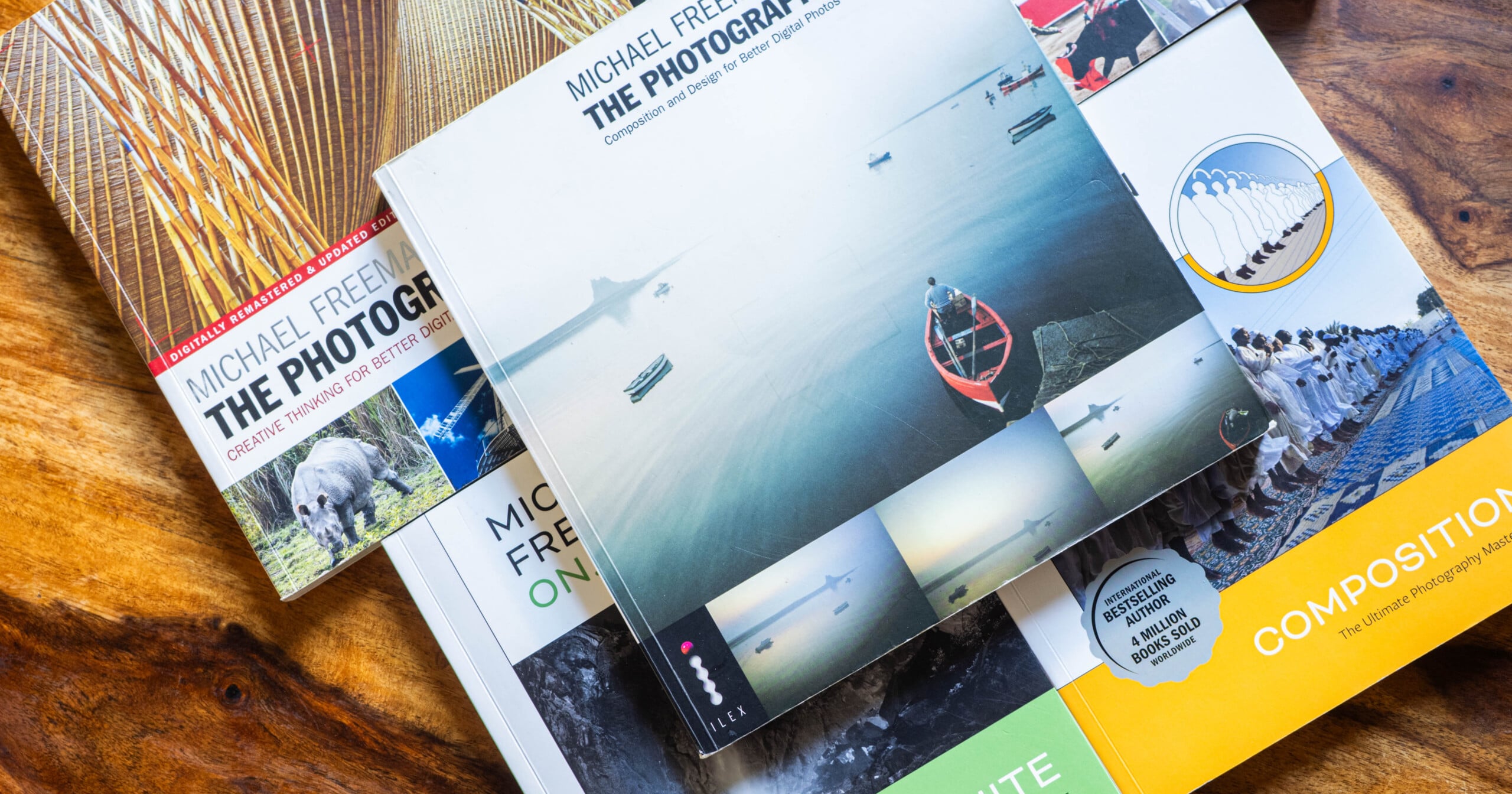
This book by Michael Freeman was the first photography manual I owned. I am going to mention a few books of his because he is one of the best photographic educators out there; his books are well-researched, well-illustrated, and well-written. They also provide a clear understanding of the topics they cover.
I first bought it back in 1981, a year after publication. That copy was lost many years ago, and I picked up another a year or so ago in a second-hand bookshop. For anyone taking up film photography, it’s a perfect introduction. However, aside from film and darkroom techniques, it clearly describes the essentials of taking photos and the equipment we use. (Quarto Publishing Ltd ISBN 0-711-2032-88)
An up-to-date version of this book by the same author is the 640-page Mastering Digital Photography (Ilex ISBN 13:L 978-907579-00-4)
I have the older version of this book, published in 2007, but it was revised last year. By the same author mentioned above, it has an enormous amount of information about composition. It’s easy to understand and, besides the widely covered topics such as symmetry and the golden section, it covers a lot of information that’s not often discussed in photography books. I find Michael Freeman’s books accessible and interesting, often looking at aspects of photography we don’t always consider.
(Published by Ilex and others, ISBN-10 1905814-04-6)
I am going to mention three books with nearly the same title here, all worth reading if you are intending to shoot weddings. The first is by Ian Gee. First published in 2001, it covers all the areas of photography to consider when shooting weddings. Apart from the different shooting scenarios, it includes good advice on charging, copyright, and insurance, and even includes a sample booking form.
(Collins and Brown ISBN 1-85585-810-X).
The next book with a similar title, “Wedding Photography Unveiled,” is by Jacqueline Tobin. It is a collection of essays by 20 top photographers. First released in 2009, it still feels contemporary in its photography and, like the other two books, features different wedding types, scenarios, and photography styles. (Amphoto Books ISBN 9 780817 459109)
The Third book, “Contemporary Wedding Photography,” is by Julie Oswin and Steve Walton. Although published in 2006, the images don’t seem dated. Again, it covers a range of scenarios, including pre-wedding shots with the groom, images of the bride preparing, reportage shots, the bride’s arrival, and the ceremony, to name but a few. However, unlike the first two books, it concentrates on white, middle-class Christian weddings, so it is lacking in some respects. But that might be down to the writers’ localities and the lack of diversity in their locations. (David & Charles ISBN 13: 978 0 7153 2461 5)
This book by Christoper Grey is one of the most comprehensive guides to studio lighting available. It starts by explaining the nature of light in a studio setting, and then the various equipment available. However, it’s the main part of the book that really comes into its own. It shows many different lighting setups and includes photos with explanations of where each was used. The book is easy to read and a great reference guide for studio photographers of all levels. (Amherst Media ISBN-13:978-1-58428-125-2)
Ross Hoddinott is one of the most highly regarded macro photographers in the world. This book, although featuring equipment from the early 2000s, is a fabulous manual covering macro techniques for most of the popular subjects that we point our macro lenses at. (Published by the Photographers’ Institute Press. ISBN 1 86108 452 8)
At any point in our photography career, we may come across unfamiliar terminology. Covering everything from Å and Abbe Condenser to Zone Plate and Zoom, it gives you a brief and understandable explanation of all things optical. Tom Ang also produces some accessible basic photography manuals. (Argentum ISBN 1-209538-1-3-7)
The first is Torson Andreas Hoffman’s book, which examines all aspects of black-and-white photography. The first chapter about cameras and sensor sizes is outdated. Then, the last section of the book concentrates on Photoshop CS3, and the world has moved a long way from that, with some outstanding alternatives to Photoshop available now. But apart from that, the other sections offer outstanding insight into all aspects of black-and-white photography and are well worth a read. (Rocky Nook ISBN 078-1-933952-27-7)
The second book was published in 1990 and, although it includes some references to film, it focuses primarily on approaching different subjects. John Garret’s book covers exposure and composition, as well as a wide range of photographic scenarios. (Mitchel Beazley ISBN 1 85732 956 2)
Some books are not intended to be instructional but are published to show off the photographer’s work. Nevertheless, there is much to learn from the images made by the world’s finest photographers. Here are some that are well worth exploring.
Although best known for his war photography, Don McCullin’s work is multifaceted. This book contains amazing photos of people living very different lives from yours or mine. Mostly perfect group shots where the subjects are aware of the camera, with a smattering of portraits and images that in a Western context would be considered street photography, the book illustrates McCullin’s perfect eye for a photo. (Jonathan Cape ISBN 0-224-075144)
Any of Joe Cornish’s books is worth buying. He is a highly respected landscape photographer, and this book illustrates his ability to use light, color, lines, shape, and form to perfection. When I first browsed this book, I assumed the photos were digital, given their sharpness and strong colors. However, they were shot with an Ebony 455 Field Camera using Fuji Velvia. If you are a landscape photographer, this is a truly inspirational book. (Jonathan Cape ISBN 0 224 075144)
The late Linda McCartney was a fantastic photographer. Like all creative people, she experimented with different techniques. This book contains reproductions of her cyanotypes and silver salted paper prints. Pleasingly, the back pages include recipes for recreating the techniques she used. (Bulfinch ISBN 0-8212-2737-8)
Lanting is a world-renowned wildlife photographer, and the reason why is reflected in the photos he included in this book. (Taschen ISBN 3-8228-2830-0)
Not all useful books are necessarily directly related to photography.
Written by Rick Rubin and Neil Strauss, this is a fabulous book to open at random. You will find exceptionally good advice that will either reinforce or challenge your beliefs. (Canongate ISBN 978-1-83885-863-6)
Meanwhile, this volume by David W. Galenson, which looks at “the two life cycles of artistic creativity, is a fascinating read. (Princeton University Press ISBN: 978-0-691-13380-5)
Another good read, Art & Fear is about the universal difficulties all artists face in creating while grappling with daily personal problems and in finding their own approach to their creative work (Image Continuum, ISBN-13 978 0 9614547 3 9).
Finally, Ways of Seeing by John Berger changed the way art criticism is considered, and how we are influenced by our beliefs about beauty, truth, our civilisation, and other factors, so we “read the language of images.” (Penguin Classics ISBN 978-0-141-03579-6)
That was just a small selection of what is in my library. I could have continued this article for another two thousand words. Are there any other books that you have found that you find particularly informative? It would be great to hear about them in the comments.