Xposure 2026: The Largest Photo Festival in the World
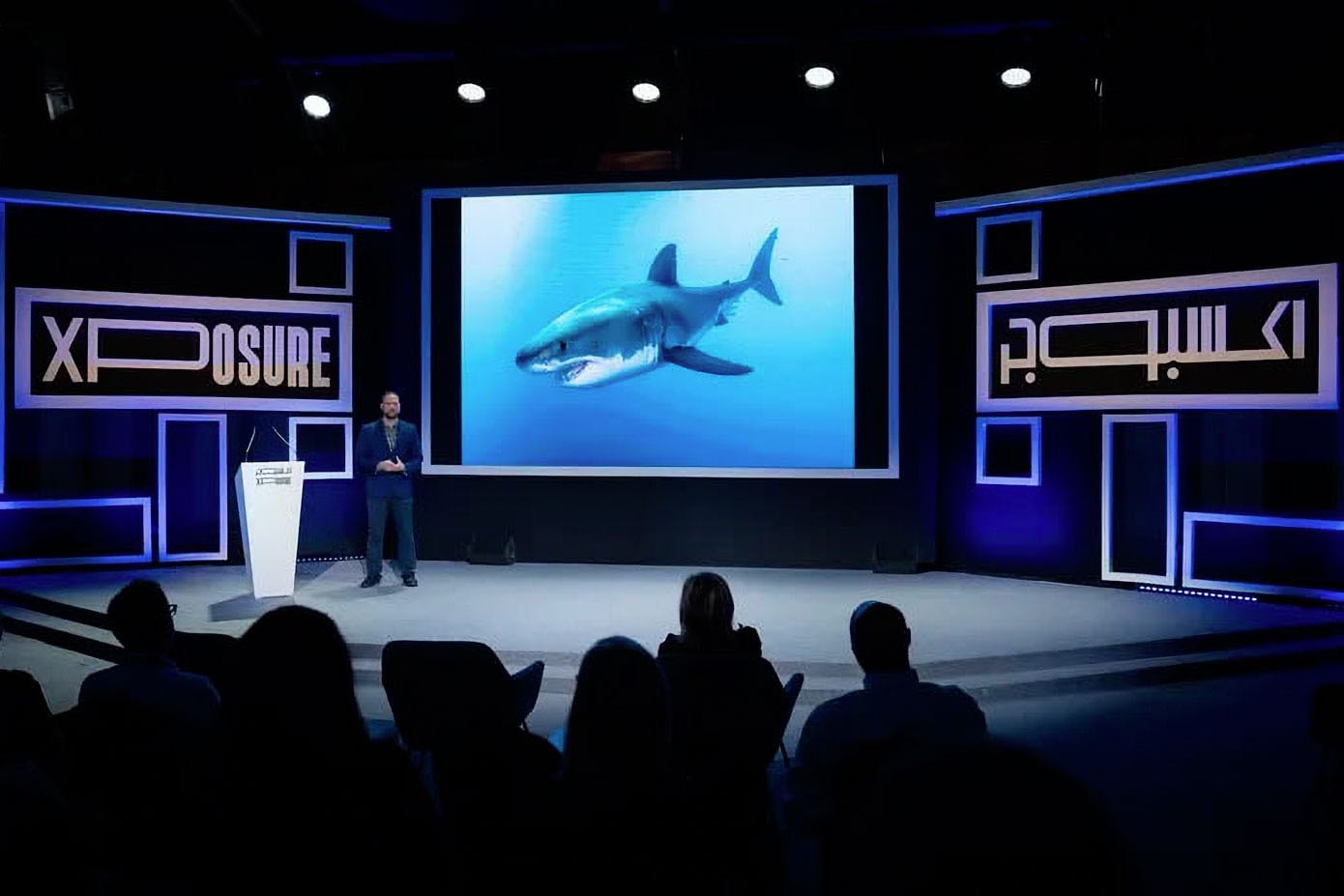
Xposure 2026 celebrated its 10th anniversary with A Decade of Visual Storytelling, featuring more than 570 creative events in Sharjah, UNESCO-designated Cultural Capital of the Arab World (1998), from January 29 to February 4, 2026.
Xposure received a record 29,000 photography and 634 film entries from 60 countries. The festival spanned both indoor and outdoor spaces, covering a single temporary venue of over half a million square feet.
Full disclosure: PetaPixel was invited as a special media guest to attend the Xposure festival in Sharjah. Xposure paid airfare, room, and board.
This year’s show was divided into 12 thematic zones to make it easier for the visitors to navigate. These zones were: People and Portraiture, Sports and Action Photography, Oceans and Water Conservation, Athens (Greece), Documentary Photography, Travel and Adventure Photography, Nature and Wildlife, The Global Focus Project (GFP), Fine Art and Creative Expression Photography, Photojournalism, addressing social issues and wars and tragedies, the Independent and Freelance Photojournalist Award (IFPA) zone, and the Courtyard zone.
The seven-day program organized by the Sharjah Government Media Bureau (SGMB) brought together leading international photographers and visual artists whose work spanned photojournalism, documentary, nature and wildlife, travel, sport, and fine art. Featured participants included David Burnett, Morten Qvale, Joshua Holko, Marco Ronconi, Mohammad Anabtawi, Simon King, Dan Kitwood, Virginie Ellis, Yousuf Ahmed, Richard L’Anson, Derry Brabbs, Deanne Fitzmaurice, and Mostafa Ajjawi.
The festival also showcased a strong fine art and creative line-up, including Christoffer Relander, Rashed Alsumaiti, Leslie Smolan, who represented the work of the late photographer Rodney Smith, Richard Le Manz, Romany Hafez, Cath Simard, Hengki Koentjoro, Pauline Planchon, Julian Calverley, Christian Houge, Dmitry Ersler, Ghada Al Qasimi, Liam Man, Riccardo Magherini, Lucia Giacani, Andrey Gudkov, and Andreas Urscheler.
The opening ceremony featured a keynote address by Haris Doukas, the Mayor of Athens, marking the Greek capital’s participation as the Guest of Honor at the festival’s landmark 10th edition. This program beautifully displayed the historic city’s centuries-old heritage, cultural transformations, and a collective showcase of more than 140 artworks by six artists.
The Athens Zone featured six independent photography exhibitions. Dimitris Tosidis documented the centuries-old pastoral nomadism of Northern Greece. Maro Kouri turned her lens on Athens’ migrant communities. Athanasios Maloukos explored the emotional states within religious rites. Socrates Baltagiannis offered an intimate portrait of Athens through the faces of its people. Antonios Pasvantis presented a decade-long study of the Evros River, which marks the natural border between Greece and Turkey. Michael Pappas documented traditional attire and costumes across Greek regions.
H.E. Tariq Saeed Allay, Director General of SGMB, said that Sharjah was not just building a photography festival but rather a new conversation between humanity and its image. Through the lens, stories cross borders faster than words. In an age where the image defines memory, commerce, and communication, Xposure has grown into a space where light becomes language and creativity becomes a form of dialogue between cultures.
The Nikon School was a key attraction offering 90-minute classes led by local photographers covering wedding, wildlife, portrait, and landscape photography. Joanna Enrique, who oversees Nikon School for the Middle East and Africa, said the program provided visitors with hands-on experience from experts in the field.
Dubai-based Hot Cold Studio, a Phase One dealer, showcased its XF IQ4 100MP medium-format system aimed at commercial photographers. Brand ambassador and marketing manager Mahmoud Chamseddin described the camera as designed for professionals who require exceptional image quality, citing its extra-large sensor and 16-bit capture.
Grand Stores, which operates showrooms in Dubai and Abu Dhabi, displayed Fujifilm’s recently launched GFX Eterna 55. M.K Trading showcased the new, ultra-fast Sigma 200mm F2 DG OS lens for sports photography, alongside a range of accessories, including camera bags, monitors, and microphones. DigiTech, based in Dubai, is an authorized distributor for Sony and Canon focused on film production equipment.
Invest Bank served as the festival’s official sponsor, contributing AED 500,000 ($136,000). The sponsorship included advertising presence across the festival site, visibility across promotional and media materials, and the use of Xposure branding on the bank’s digital platforms. In addition, Invest Bank allocated AED 500,000 to acquire photographic works by participating photographers exhibited at the festival.
The focus groups were 40-minute roundtable discussions that created an interactive space for students and amateur photographers to engage directly with leading photographers and filmmakers. Topics covered included creative processes, industry trends, ethics, storytelling techniques, post-production, and personal career journeys. In each session, mentors encouraged open debate using slides, images, or film, while attendees shared their perspectives and experiences.
In one such group, photographer Shoayb Khattab discussed with participants, both amateur and professional, the pros and cons of including the human element in architectural photography.
Portfolio reviews were a popular stepping stone for most beginning and intermediate photographers looking to further hone their skills. This also helped connect them to photo editors, curators, and industry professionals to strengthen and modify their work.
Saeed Rezvanian, a fine art photographer from Iran who won a prize in the Photo-manipulation and AI category, was granted two complimentary portfolio review sessions, which he gladly participated in. One was with art curator and consultant Anke Degenhard, who played a major role in assembling portfolios of renowned artists, including Helmut Newton, Peter Lindbergh, and Horst P. Horst. He later told me over lunch that he did benefit from the critique.
Degenhard explained that her extensive industry experience enables her to provide practical guidance to photographers seeking to develop their careers and artistic direction. She noted that she has more than 30 years of experience and has conducted around 3,000 portfolio reviews.
The international portfolio review panel included Aidan Sullivan, CEO and founder of Verbatim Photo–Visual; Claire Harbage of NPR; Pulitzer Prize winner Essdras M. Suarez; industry experts Gilles Cargueray and Frank Meo. Additional reviewers included the photojournalist with Getty Images, Giles Clarke; Kathy Moran, former senior editor at National Geographic; Lars Boering, founder of Triggertale.com, two-time Pulitzer Prize winner Mohammed Muheisen; Samantha Clark, Managing Photo Editor at National Geographic; Interdisciplinary specialist Dr. Wiktoria Michałkiewicz, and Dr. Yannis Kontos, documentary photographer and Assistant Professor at United Arab Emirates University (UAEU).
There were back-to-back workshops every day, totaling 72 over seven days, covering topics ranging from large-format photography to AI to underwater photography and everything in between.
On the opening day itself, there were eight workshops. There were two interactive sessions led by Peter Chanthanakone, a Canadian animator and Assistant Dean at Zayed University in Dubai. Titled Synthesized Dreams: Redefining Animation through AI, the workshops demonstrated the fundamentals of AI-assisted image creation and basic animation. Students from the University of Sharjah joined festival attendees to learn about new generative technology and its day-to-day applications.
Street photographer Vineet Vohra led a practical session on how to identify and shape everyday street scenes into strong images.
Landscape photographer Mohammad Anabtawi demonstrated his technique of creating expressive landscape photos while exercising technical control in the field.
Yousuf Ahmed, a member of the Emirates Astronomical Society, loves photographing the night sky. He has spent a year capturing the cosmos, star clusters, galaxies, and meteor showers, and has had an enduring relationship with the stars. The Sky – Within and Beyond was displayed in the Nature Zone and showed the tranquility and power of the skies.
Rashed Alsumaiti, who works in IT, finds it fascinating to photograph the microscopic world. He began with landscapes in 2009, but soon moved on to photographing structures invisible to the naked eye.
Alsumaiti captures everyday substances such as salt and vitamin C crystals at extreme magnification to produce colorful, dramatic landscapes and abstract forms. He displayed his Dancing Crystals at the Fine Art and Creative Expression Zone.
Ghada Ahmed Al Qasimi, focused on memory, silence, and the feelings that resist clear definition. Rather than presenting direct narratives, her photographs function as quiet reservoirs of emotion, inviting viewers to pause and reflect.
Silence, her series showcasing the tension between presence and absence, was shown at the Fine Art and Creative Expression Zone.
The Independent and Freelance Photojournalist Award was presented jointly for the first time since its inception. The jury announced Josh Edelson as co-winner for his project Inferno: California on Fire, alongside Nicole Tung for Ukraine: The Shortest Goodbye.
The two winning projects were selected from a shortlist of eight finalists. Edelson documented the devastating environmental and human consequences of large-scale wildfires in the United States, offering a stark visual account of climate-driven disasters. In contrast, Tung recorded intimate moments of loss and separation amid war, presenting a powerful human narrative shaped by conflict and displacement.
The Global Focus Project (GFP) returned to Xposure 2026 this year as a dedicated Zone. Photographers could not apply directly but had to be nominated by recognized photography professionals. The program, with a focus on long-form documentary work, honored one outstanding male and female photographer from each of the six continents: Asia, Africa, North America, South America, Europe, and Oceania.
Here are the twelve award winners under the Global Focus Project.
Nigerian photographer Oyewole Lawal created Earth’s Frontline Guardians of Gaia: The Unseen Eco-Warriors. He spent extended time at Olusosun, Africa’s largest landfill, documenting waste workers whose daily labor quietly reduced environmental harm.
In White Gold, Egyptian photographer Amina Kadous examined the intersection of personal memory and the official history of Egyptian cotton.
In The Yellow River, Chinese photographer Kechun Zhang traced the country’s most symbolic river with expansive images that reflect environmental loss alongside the land’s resilience.
In Out of Gaza, Palestinian photographer Samar Abu Elouf documented humanitarian efforts to provide medical care to wounded civilians outside the territory.
Canadian photojournalist Amber Bracken, widely recognized for her reporting on Indigenous rights, documented the Wet’suwet’en Resistance (a movement in northern British Columbia opposing pipeline projects) in unceded territory.
In With No Ithaca Awaiting (Ithaca from Homer’s Odyssey, the mythical home that Odysseus struggles to return to), Mexican photographer Felix Márquez, a Pulitzer Prize-winning visual journalist, traced migration across Mexico, offering a deeply human account of displacement shaped by violence, climate pressure, and exclusion.
Alessandro Cinque presented El Precio de la Tierra (The Price of Land), an eight-year journey through mining communities in Peru, exposing the human cost of extraction, from contaminated water to long-term health damage.
In Portraits of the Multiverse, Peruvian artist Ana Sotelo collaborated with Shipibo Kené (a traditional geometric design created by the Shipibo-Conibo people of the Peruvian Amazon) master Sadith Silvano to merge photography with ancestral embroidery.
In SILA (in the Greenlandic language, literally weather), Slovenian photographer and National Geographic Explorer Ciril Jazbec followed Inuit youth on Uummannaq Island in Greenland to capture resilience, grief, and belonging at the frontline of climate change.
In When the Smoke Clears, American photographer Svet Jacqueline, now based in Ukraine, documented civilian life, including underground classrooms, families sheltering at night, and children playing among the ruins.
In Oceania, land is both witness and inheritance. Australian photographer Aletheia Casey recorded the results of the country’s catastrophic wildfires in A Lost Place.
In Out of Context, French artist Joel Benguigui, working between Australia, Europe, and Southeast Asia, presented a slow, film-based meditation on how belonging is shaped not only by geography but also by memory, movement, and return.
The Xposure Legacy Awards are a new cultural initiative launched by the festival this year. They are granted exclusively to exhibitions that celebrate visual storytelling as a long-term knowledge resource. The awards are divided into three main categories and follow a dual-evaluation model that combines public engagement and expert critical assessment.
The Noor Ali Rashid Legacy Award for Documentary Vision, which recognizes documentary exhibitions addressing humanitarian and social issues with honesty and responsibility, was awarded to Giles Clarke for A Decade Documenting Humanitarian Crises.
The Saleh Al Ustad Legacy Award for Creative Photography, which celebrates creative excellence and artistic innovation in photography, was awarded to Dmitry Ersler for Russia at Dusk. The BEEAH Award for Environmental and Conservation Photography, sponsored by BEEAH, was awarded to Greg Lecoeur for A Vibrant Sea.
The Xposure International Photography Awards 2026 received more than 29,000 submissions from over 60 countries, setting a record for the highest participation in the awards’ history.
Outstanding photographers from around the world were feted for their work that demonstrated exceptional visual storytelling, technical skill, and creative depth across a wide range of genres.
Overall winner of the Photography Award was presented to Myanmar’s Myat Hein for A Portrait of Resilience, selected for its emotional depth, narrative strength, and powerful visual impact.
Architectural Photography category saw Hans Wichmann from Germany claiming first place for Antinori Winery, while Olga Nezmeskalova from the Czech Republic secured the runner-up for David and Goliath.
Mobile Photography had Si Thu Ye Myint from Myanmar win first place for A Day in the Life of a Farmer Family, with Chinese Yajun Hu named runner-up for A Gazing Cat.
Nature & Landscape Photography got UAE’s Preeti John first place for The Conversationalists.
Russian Sergey Gorshkov was lauded, too, for his Elephant at Sunset.
Night Photography award was claimed by Marian Kuric from Slovakia for Fairy Tale, with Htin Lin from Myanmar placing second for the bewitching photograph Night of Fishermen.
Photo-manipulation and AI category saw two Iranian recipients win. Maryam Sadat Ahmadi secured the top prize with Myself, a stunningly perplexing selfie, just ahead of compatriot Saeed Rezvanian with his photograph Untitled.
Portraiture Photography category awarded first place to Aung Kyaw Zaw from Myanmar for The Two Face, with Malaysian Yuji Haikal receiving recognition for Lost in Translation.
Sports Photography had Ahmad Damra from Jordan taking the honors for his pole-vaulting image, Strength in the Curve of Challenge. At the same time, Muhammad Al-Jalandi from Oman was declared runner-up for Dreams Beyond Limit.
Street Photography award went to Mexican Antonio Flores for the faux bull-fighting scene Dance with the Giant of the Fire, with Aimin Chen from China landing the runner-up slot for Walk on Stilts.
Visual Storytelling category, saw Bob Miller from the United States triumphing in first place for The Last Generation. It’s All in My Head, from Nigerian Etinosa Yvonne, received the runner-up prize and loud applause.
Junior Photography category, open to UAE residents aged 7–17, recognized young visual storytellers across two age groups. In the Lower Junior (7–13 years) category, Ishaan Shyjith won for Pathways in Motion, with Abdalla AlSuwaidi runner-up for Heritage and Culture. In the Upper Junior (14-17 years) category, Neel Anil claimed first place for The March and the Mimics, while The Silent Custodian by Badr Alsayed took home the second-place accolade.
There were 634 film entries from 60+ countries. The International Film Awards 2026 honored global filmmakers whose work demonstrated purposeful storytelling and cinematic craft.
Best Cinematic Arts. Danish Farhan, UAE, for Bedouins of the Wind, Kazakhstan’s Maxim Akbarov, runner-up for Steppe.
Best Visual Effects. Iran’s Majid Farzolahifor Story of the Earth: Anarchy, and fellow Iranian filmmaker Mahdi Hadizadeh, runner-up for Holy Death.
Best Documentary Feature. Caspar Diederik fromthe Netherlands for Muga, When She Stops Flowing, So Will We, Portugal’sFernando Teixeiranamed runner-up for Wilder Côa.
Best Short Film. Latvia’s Sergios DeLaurentisfor Crimson Silence, Palestinian filmmaker Ahmed Deeb,runner-up for Farfour: A War Diary from Gaza.
Xposure Achievement Award in Film and Documentary. Abraham Joffe for Trade Secret, which also made its UAE premiere at the festival. The award honored his sustained body of work exploring the complex relationships among people, wildlife, and the systems that shape the natural world.
The Conservation Summit on February 2, under the theme Troubled Waters, drew a large crowd and was attended by H.H. Sheikh Sultan bin Ahmed bin Sultan Al Qasimi, Deputy Ruler of Sharjah.
Global photographers, scientists, and explorers led critical conversations on the future of marine ecosystems. There was a comprehensive program based around multiple core themes.
Brian Skerry, veteran photojournalist and documentary filmmaker, led the session Ocean Soul Jennifer Adler, Shane Gross, Greg Lecoeur, and Pippa Ehrlich spoke in the session Troubled Waters Five solo exhibitions within the Ocean and Marine Conservation Zone.
The theme underscored the oceans’ role as the planet’s first line of defense against climate change and carbon pollution. Studies show that oceans absorb 91% of excess heat and 29 % of global carbon emissions. Despite this, industrial activity, pollution, and overfishing are placing unprecedented pressure on marine ecosystems, with projections warning that thousands of marine species could face extinction.
The Conservation Summit was ably supported by five solo exhibitions presented throughout the festival within the Ocean and Marine Conservation Zone. In Coral: Toward Fading and Extinction, underwater photographer Alp Can, whose work focuses on coral reef ecosystems and conservation science, highlighted the urgent need to protect reefs from degradation caused by industrial activity, pollution, and climate change.
In A Vibrant Sea, Greg Lecoeur, an award-winning French underwater photographer recognized for his long-term work in the Mediterranean, documented the region’s marine biodiversity and fragile ecosystems. Hidden Ocean Treasures by Shane Gross, a Canadian photojournalist known for revealing overlooked natural behaviors, presented intimate underwater stories that underscore the complexity and vulnerability of marine life.
In Forests of the Ocean, Jennifer Adler, a National Geographic Explorer and marine science photographer, showed underwater forests over three years across North America, Asia, Australia, and Antarctica, highlighting their ecological value and the importance of scientific research and conservation. Brian Skerry, a National Geographic Explorer and leading ocean storyteller, presented Ocean Soul, a visual narrative that portrayed the ocean as a living ecosystem and underscored humanity’s responsibility to protect and preserve it.
Here, frontline photographers document war, migration, and long-term social change through work grounded in lived experience. From war zones and migration routes to communities living through prolonged crisis, the Photojournalism Zone brings together photography created under risk and driven by the need to bear witness.
The Photojournalism Zone is structured around two core categories: Social Issues and War & Tragedies.
The Social Issues theme brings together long-term documentary projects that examine how people live within systems shaped by change and pressure. These bodies of work are based on sustained observation rather than breaking news, allowing social conditions to emerge over time.
Lisbon-based documentary photographer Ricardo Lopes represents this approach through Blessed Ground. This project reflected his transition from daily news coverage to long-form visual investigations examining the social effects of economic and environmental change.
Ilvy Njiokiktjien drew on nearly two decades of experience documenting post-apartheid South Africa in Born Free – Mandela’s Generation of Hope, which followed a generation grappling with entrenched economic inequality.
Carol Allen-Storey presented Defying the Myth: A photographic Journal of Love, Resilience, and Survival, focusing on communities affected by conflict and disease, with particular attention to women and children.
Iranian-Canadian photographer Kiana Hayeri, who lived in Kabul for 8 years, documented daily life in Afghanistan through No Woman’s Land, with a sustained focus on women and adolescents navigating shifting social realities.
Migration and displacement were explored through Olivier Jobard’s Our Afghan Family: A Memory of a Life Gone By, produced through years of close engagement with migrant journeys across borders.
Paul Lukin examined the psychological dimensions of isolation and displacement in Shadows of Solitude, using restrained black-and-white photography to reflect inner states of uncertainty and loss.
Smita Sharma extended this examination through We Cry in Silence, a visual investigation into human trafficking and violence in South Asia, also published as a book.
This work was produced under extreme conditions, where photography functions as testimony shaped by risk, urgency, and consequence.
Michael Christopher Brown is recognized for his pioneering use of smartphone photography during the Libyan revolution in The Difference Between Bullets and Stones, a project rooted in first-hand experience on the front line.
Iraqi American photographer Salwan Georges presented The Syria I Found Again, documenting contemporary crises from Ukraine to the Middle East through images that have since been added to the US Library of Congress.
María Ximena Borrazás Cataldo focused on the war in Ethiopia’s Tigray region in The Scars of the War, examining the human impact of violence and famine through award-winning work produced under restricted conditions.
From Syria, Ali Haj Suleiman presented A Fight for the Truth, drawing on years of documentation of displacement and human rights violations in Idlib, produced in collaboration with international organizations.
The category concluded with A Decade Documenting Humanitarian Crisis by Giles Clarke, whose career spans major emergencies in Yemen, Somalia, and Haiti. It includes field missions alongside former UN Secretary-General Ban Ki-moon.
At a time when images are increasingly shaped by manipulation, speed, and spectacle, Xposure turned its attention back to the human face as one of the most enduring records of truth. This Zone examined portrait photography as a space where identity, memory, and lived experience are held with care, responsibility, and depth.
The Zone presented six exhibitions by photographers working across documentary, cinematic, and research-driven practices. Together, the works reflected how portraiture continued to bear witness to personal and collective histories.
The Zone positioned the portrait not as a static image, but as a long-term relationship between the photographer and their subject. Across the exhibitions, faces became archives of survival, belonging, loss, and cultural identity, revealing how the human story unfolds over time rather than in a single moment.
6 photographers, 6 Approaches to Portraiture
Tarik Khoja approached the portrait as a study of visual identity, drawing from heritage, place, and the subtle codes of belonging that shape how individuals are seen within their societies. His portraits were mostly of Saudi women in fine clothing and jewelry, shot in a studio.
Deanne Fitzmaurice contributed one of the most recognized long-form human narratives of recent decades through Operation Lion Heart, along with other stories on The Horizons of Identity. This was a San Francisco Chronicle multi-part feature by reporter Meredith May with photographs by Deanne Fitzmaurice that followed the real-life journey of Saleh Khalaf, a young Iraqi boy who survived devastating injuries from a roadside bomb in 2003. The series chronicled his almost miraculous medical rescue, recovery, and emotional struggles at Children’s Hospital Oakland and the efforts to reunite him with his family, capturing both the harsh human impact of war and his remarkable resilience. Fitzmaurice’s powerful images in the series earned her the 2005 Pulitzer Prize for Feature Photography.
Ana Backhaus works within the intimate territory of the family archive, using documentary photography to trace memory, intergenerational connection, and loss as lived experience rather than subject matter.
Pete Muller is a London-based advertising photographer known for his bold, cinematic approach to portraiture and sport. He has created images that resonate with his commercial clients.
In The Faces of Mexico: A Study in Truth & Perception, Richard Cawood challenged the boundaries of photographic truth through high-contrast portrait studies informed by his research into artificial intelligence and perception.
Mohammed Muhtasib, a photographer from Jeddah, Saudi Arabia, has captured women around the world. Women: Stories in Pictures, grounded in lived experience rather than staged symbolism, reveals the many roles women play. Each image carries a story, reflecting the layered identities and responsibilities women hold at different stages of life. It asks us to look more closely, listen more carefully, and recognize not only what women do but also who they are.
Beyond the exhibitions, the Zone featured a program of live talks led by participating photographers, offering audiences insight into how portraits were conceived, developed, and sustained over time. The sessions addressed not only image-making techniques but also the ethical questions that arise when working with trauma, vulnerability, and personal histories.
The Documentary Zone was dedicated to long-form visual projects grounded in research, fieldwork, and storytelling. The zone featured 13 exhibitions by photographers representing diverse approaches and schools of practice, addressing themes including climate change, displacement, identity, memory, and cultural customs and traditions. Together, the exhibitions invited visitors to experience photography as a complete visual narrative, grounded in ethical responsibility and truthful documentation.
To further strengthen public engagement with documentary photography, Xposure 2026 hosted a series of talks and workshops in which visitors met photographers exhibiting in the Documentary Zone. The talks explored how long-term projects were developed, examined the challenges of field photography in sensitive and high-risk environments, and discussed the ethics of documentary visual storytelling.
Exhibitions in the Documentary Zone included prominent practitioners such as Michael Yamashita, one of National Geographic’s most recognized photographers; Tomasz Tomaszewski, known for human-centered work in sensitive environments; Philippe Chancel, whose documentary projects examine political change and identity; and Anush Babajanyan, noted for extended field projects in conflict zones and contexts of social transformation.
Within the environment and climate theme, the exhibitions offered visual readings of how environmental shifts affect local communities, from coastal erosion and declining natural resources to changing ways of life in communities impacted by agricultural challenges.
Several projects examined the human–land relationship as both threatened and enduring, including exhibitions documenting ecological change in coastal regions and in inland lakes facing severe shrinkage.
Conflict seen through the lens
The conflict, displacement, and social transformation theme brought together projects that document the impact of war and major political change on individuals and communities. Through long-term follow-up in places shaped by conflict, displacement, or acute social shifts, the exhibitions presented photography as a tool for understanding what follows the headline moment and how life continues when a place is lost or the social fabric of a community is fundamentally altered.
Places as holders of memory and identity
Exhibitions focused on the relationship between people and their cultural and urban environments. The film program started as part of the Opening Ceremony with Visual Stories That Change Everything, a live conversation between media presenter Kris Fade and international film and television executive Sanford R. Climan (producer of The Aviator, nominated for Best Picture Oscar), documenting rituals and religious practices, and holding abandoned architecture as a witness to time and transformation. Projects in this theme treated place as a carrier of memory, whether in traditional villages and communities, or in buildings and sites that have lost their function but retained their imprint.
Photography as scientific inquiry
The science and visual research theme highlighted projects that translate scientific knowledge into accessible visual storytelling. Several exhibitions focused on climate research, the polar regions, deep ice samples, and marine environments, positioning photography as a bridge between scientific data and public understanding without compromising accuracy.
Cinema shaped the direction of Xposure 2026. A series of film-focused conversations, presented by industry voices, examined cinema’s cultural role and global influence.
Studio executive and producer Glenn Gainor, who has held senior leadership roles across major Hollywood studios, joined Oscar-winning producer Odessa Rae, known for The Voice of Hind Rajab, for a panel discussion on cinema as soft power and its influence on public discourse.
The program also featured cinematographer Abraham Joffe, known for his work on the Netflix documentary mini-series Our Oceans. Joffe presented the UAE premiere of Trade Secret: You Thought They Were Protected, followed by a live discussion with journalist Adam Cruise examining investigative filmmaking, conservation storytelling, and ethical responsibility.
There was also a series of paid film workshops led by internationally recognized filmmakers.
Oscar-winning filmmaker Martin Desmond Roe led an intensive, multi-day workshop that guided participants through the complete process of making a short film, from concept to final edit.
The wider workshop program also included sessions examining the impact of artificial intelligence on the film industry, the relationship between screenwriting and performance, and the foundations of professional acting.
66 films were screened over seven days, delivered through dedicated indoor cinema spaces, with selected screenings also taking place in the newly introduced outdoor viewing areas within the festival grounds. The screening program featured documentary, narrative, and experimental films by photographers and filmmakers participating in the festival.
TBHF presented ‘Traces of Memory, The Son of Sharjah’, a humanitarian photography book developed through an institutional collaboration between the Executive Office of H. H. Sheikha Jawaher bint Mohammed Al Qasimi and The Big Heart Foundation. TBHF has donated more than AED 3,000,000 (≈$800,000) to 6 million people in more than 37 countries.
The exhibition features a curated selection of photographs captured by H. H. Sheikh Sultan bin Ahmed Al Qasimi, Deputy Ruler of Sharjah and Humanitarian Envoy of TBHF, during field visits accompanying the Foundation’s humanitarian work across several countries.
The exhibition also featured Carrying Home, a second photography book that provided a broader visual reading of TBHF’s humanitarian engagement in contexts of displacement. Through images that highlight resilience, continuity, and everyday life, the publication reflected the Foundation’s long-term commitment to supporting affected communities beyond immediate emergency response.
There were just too many photographers, either exhibiting, speaking, interviewing, presenting, or in other roles, and all of them could not be covered in the above report. So, the missing honorable mentions are:
Canadian photographer Tim Smith, British Photographer Liam Man, Egyptian photographer Fatima Fahmy, Argentinian photographer Guillermo Franco, French photographer Jean-Pierre Rieu, Swedish photographer Lukasz Larsson Warzecha, French photographer Matilde Gattoni, American photographer Huang Qingjun, Turkish photographer Mustafa Bilge Satkın, British-Swedish photographer Anastasia Taylor Lind, American photographer Rick Smolan, Photo historian Sylvia Laudien-Meo, Greek photographer Christina Kalligianni, French photographer & master printer Dominique Laugé, UAE photographer Hind Al Raeesi, Filipino photographer Jan Gonzales, UAE photographer Jassim Rabia Al-Awadhi, UAE photographer Mohamed Alsuwaidi, Danish photographer Søren Solkær, Greek photographer Thanassis Stavrakis, German photographer Tor Seidel, Swedish photographer Ulrika Larsson, Greek photographer Yannis Kolesidis, UAE photographer Ahmed Alshehhi, UAE photographer Ali Alsharif, Egyptian photographer Mohamed Elnadry, UAE photographer Omran Alansari.
When I set out from Atlanta, I thought seven days was too long to spend at a photo exhibition, but I had no idea how vast it was. On the final day, I had to accept that I had barely scratched the surface, and I was furiously running to catch up with all the 95 galleries out there. In the future, it would be nice if the organizers launch a detailed online Xposure after the physical show ends, so I can catch up on what I missed during the long flight back, or for the benefit of people who could not travel.
All uncredited photos by Phil Mistry.
About the author: Phil Mistry is a photographer and teacher based in Atlanta, GA. He started one of the first digital camera classes in New York City at The International Center of Photography in the 90s. He served as the director and instructor for Sony/Popular Photography magazine’s Digital Days Workshops. You can reach him here.