Images of Ultra-Rare Cosmic Calamity Unravel a Longstanding Mystery
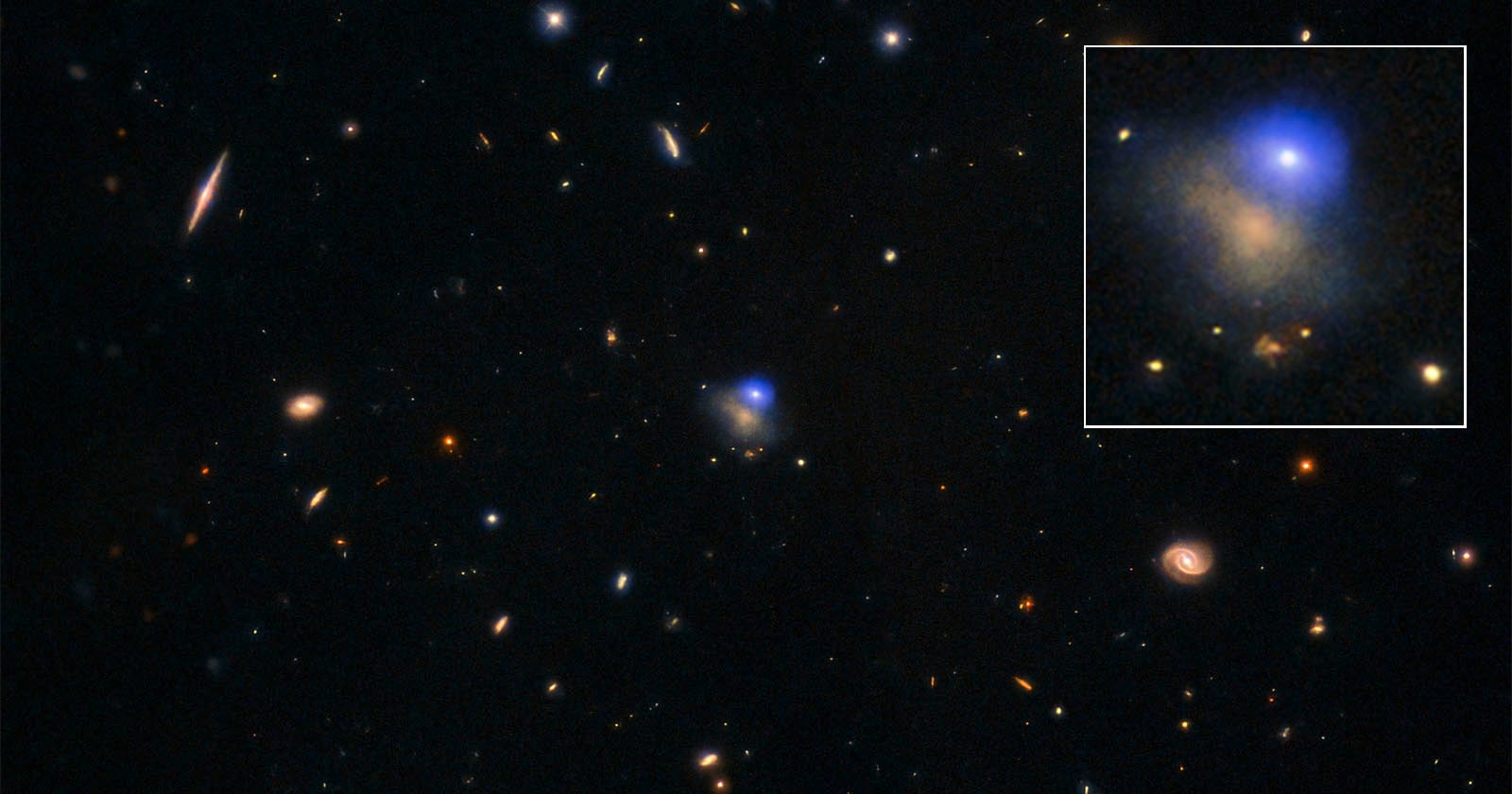
Last year, astronomers discovered the brightest Luminous Fast Blue Optical Transient (LFBOT) ever observed. A complete understanding of this type of event, an exceptionally bright blue flash that quickly fades, has long eluded scientists. However, a new analysis of the brightest burst last year has unlocked key insights into the event, and scientists now believe the blue cosmic outburst is caused by black holes shredding massive cosmic companions, like stars.
NOIRLab describes LFBOTs as “among the more puzzling cosmic phenomena discovered over the past few decades,” adding that only slightly more than a dozen of these events have been discovered so far. Astronomers have long debated whether LFBOTs are a distinct type of supernova or are caused by interstellar gas falling into black holes.
However, analysis of last year’s super-bright LFBOT, named AT 2024wpp, shows that neither of those leading theories is correct. A research team at the University of California, Berkeley analyzed AT 2024wpp and determined that the event, and likely other LFBOTs, are caused by “an extreme tidal disruption, where a black hole of up to 100 times the mass of our Sun completely shreds its massive star companion within days.”
That blue flash caught last year on multiple telescope cameras was light caused by an extreme cosmic event — a black hole tearing a star apart.
LFBOTs are exceptionally powerful events. They are visible over vast distances, up to billions of light-years, and produce high-energy light ranging from visible blue light to ultraviolet and X-rays. Based on the light emitted by AT 2024wpp, scientists determined that it could not have been a supernova. The LFBOT emitted about 100 times more light than a supernova can produce.
Observations from the Gemini South telescope showed evidence that there was “an excess of near-infrared light emitted from the source.” This is just the second time scientists have observed this sort of phenomenon.
“The sheer amount of radiated energy from these bursts is so large that you can’t power them with a core collapse stellar explosion — or any other type of normal stellar explosion,” says Natalie LeBaron, UC Berkeley graduate student and lead author on the new research paper about the Gemini data. “The main message from AT 2024wpp is that the model that we started off with is wrong. It’s definitely not just an exploding star.”
LeBaron and other researchers hypothesize that the high-energy light resulted from a parasitic cosmic relationship over many years. A black hole in a binary system sucked material from its companion star for “a long time,” although the star remained too distant for the black hole to swallow it up. At some point, the companion star finally got a bit too close.
“Then, when the companion star finally got too close and was torn apart, the new material became entrained into the rotating accretion disk and slammed against the existing material, generating X-ray, ultraviolet, and blue light. Much of the gas from the companion also ended up swirling toward the poles of the black hole, where it was ejected as a jet of material. The team calculated that the jets were traveling at about 40% of the speed of light and generated radio waves when they encountered surrounding gas,” Noirlab says.
Gemini South was one of a larger collection of telescopes used to measure the wavelengths of light emitted by the LFBOT. X-ray telescopes used to collect data include NASA’s Chandra X-ray Observatory, the Swift-XRT, and the Nuclear Spectroscopic Telescope Array (NuSTAR). Radio telescopes like the Atacama Large Millimeter/submillimeter Array (ALMA) and CSIRO’s Australia Telescope Compact Array (ATCA) were used as well. The Ultra-Violet/Optical Telescope (UVOT) on NASA’s Neil Gehrels Swift Observatory and ground-based optical telescopes were also used. The final composite includes imagery from the Hubble Space Telescope as well.
Scientists estimate that the shredded star was about 10 times the mass of the Sun and may have been a Wolf-Rayet star, a very hot, evolved star that has already exhausted much of its hydrogen.
“This would explain the weak hydrogen emission from AT 2024wpp,” NoirLab concludes.
Image credits: International Gemini Observatory/CTIO/NOIRLab/DOE/NSF/AURA/NASA/ESA/Hubble/Swift/CXC/ALMA (ESO/NAOJ/NRAO). Image processing: Image Processing: J. Miller & M. Rodriguez (International Gemini Observatory/NSF NOIRLab), T.A. Rector (University of Alaska Anchorage/NSF NOIRLab), D. de Martin & M. Zamani (NSF NOIRLab). Associated research is from “The Most Luminous Known Fast Blue Optical Transient AT 2024wpp: Unprecedented Evolution and Properties in theUltraviolet to the Near-Infrared” by LeBaron et al.